
How might it affect the dissertation evaluation process?
If you’re working on an interdisciplinary PhD and need support with your proposal, thesis, or data analysis, we’re here to help you move forward with confidence. See our PhD help services.
Pursuing an interdisciplinary research project during a PhD is associated with more innovative findings and broader skill development, but it can also introduce challenges in dissertation evaluation and career progression due to disciplinary boundaries and evaluation norms.
1. Introduction
Interdisciplinary research during doctoral studies has gained prominence as a means to address complex global challenges and foster innovation. Multiple studies indicate that engaging in interdisciplinary research enhances creativity, problem-solving skills, and research adaptability, often leading to more innovative findings and broader career readiness for PhD graduates (Rana, Aitken and Chimoriya, 2025; Ramachandran et al., 2022; Carr, Loucks and Blöschl, 2018; Liu et al., 2023; Ke, 2020; Bosque-Pérez et al., 2016; Christensen et al., 2021; Barley et al., 2025). However, the process is not without challenges: interdisciplinary dissertations may face difficulties in evaluation due to disciplinary silos, differing academic cultures, and ambiguous assessment criteria (Zait and Andrei, 2020; Newman, 2023; Ingersen et al., 2023; Purvis et al., 2023). While universities and funding agencies increasingly promote interdisciplinary approaches, evidence suggests that such research can be undervalued in traditional academic evaluation systems, potentially impacting funding success and early career progression (Sun et al., 2021; Bromham, Dinnage and Hua, 2016; Rhoten and Parker, 2004; Purvis et al., 2023). Despite these barriers, the long-term benefits of interdisciplinary research—such as increased collaboration networks, broader societal impact, and improved funding performance—are well documented (Sun et al., 2021; Liu et al., 2023; Ke, 2020; Barley et al., 2025). This review synthesises the literature on the outcomes of pursuing interdisciplinary research during a PhD, with a focus on innovation and dissertation evaluation.
Figure 1: Consensus meter: Does interdisciplinary PhD research increase innovation and affect dissertation evaluation?
2. Methods
A comprehensive literature search was conducted across over 170 million research papers in Consensus, including sources such as Semantic Scholar and PubMed. The search strategy involved 21 unique queries targeting interdisciplinary research during PhD studies, innovation outcomes, and dissertation evaluation processes. In total, 1,078 papers were identified, 753 were screened, 544 were deemed eligible, and the top 50 most relevant papers were included in this review.
| Identification | Screening | Eligibility | Included |
|---|---|---|---|
| 1078 | 753 | 544 | 50 |
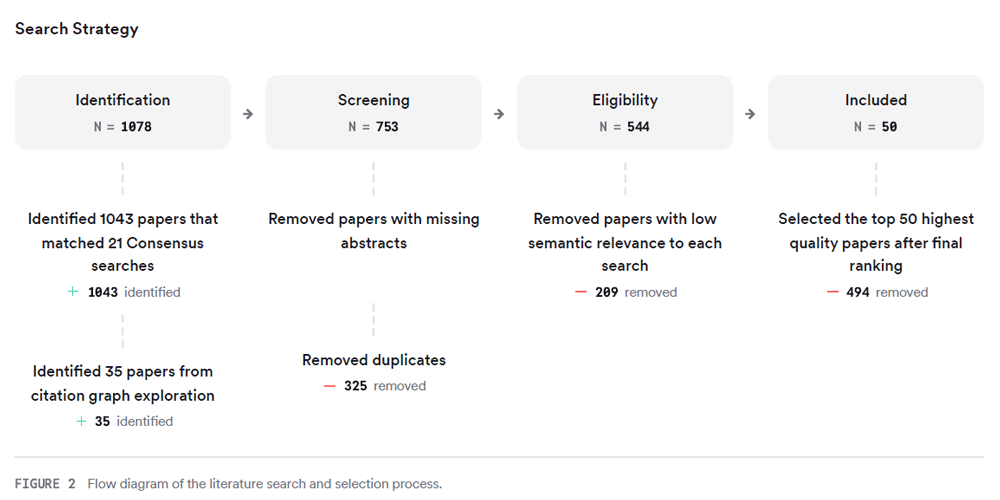
Figure 2: Flow diagram of the literature search and selection process.
Twenty-one unique searches were executed, focusing on interdisciplinary doctoral research, innovation, and dissertation assessment.
3. Results
3.1. Interdisciplinary Research and Innovation Outcomes
Interdisciplinary doctoral research is consistently linked to increased innovation, broader perspectives, and enhanced problem-solving skills. Integrating concepts and methodologies from multiple disciplines fosters novel ideas and solutions, often resulting in more creative and impactful research (Rana, Aitken and Chimoriya, 2025; Ramachandran et al., 2022; Liu et al., 2023; Ke, 2020; Bosque-Pérez et al., 2016; Christensen et al., 2021). Empirical studies show that interdisciplinary publications tend to attract more citations and have higher societal visibility, with a 20% increase in research impact at the article level when more disciplines are integrated (Liu et al., 2023; Ke, 2020). However, the innovative benefits may take longer to materialise, as interdisciplinary work often garners recognition over extended periods (Sun et al., 2021; Ke, 2020).
3.2. Dissertation Evaluation and Academic Challenges
Despite the innovative potential, interdisciplinary dissertations face unique evaluation challenges. Traditional academic structures and assessment criteria are often discipline-specific, making it difficult to fairly evaluate interdisciplinary work (Zait and Andrei, 2020; Newman, 2023; Ingersen et al., 2023; Purvis et al., 2023). Interdisciplinary projects may be perceived as less productive or more difficult to publish, especially in high-impact, discipline-focused journals (Zait and Andrei, 2020; Newman, 2023; Purvis et al., 2023). Early-career researchers may experience professional risks, including slower career progression and lower short-term citation impact (Sun et al., 2021; Rhoten and Parker, 2004; Purvis et al., 2023).
3.3. Institutional and Funding Contexts
Universities and funding agencies are increasingly supporting interdisciplinary research through structural changes, dedicated centers, and targeted funding programs (Leahey and Barringer, 2020; Bosque-Pérez et al., 2016; Biancani et al., 2018; Barley et al., 2025). While interdisciplinary researchers may initially face lower funding success rates, long-term analyses reveal that they eventually outperform their specialised counterparts in both funding volume and value (Sun et al., 2021; Bromham, Dinnage and Hua, 2016; Ke, 2020; Barley et al., 2025). Institutional support, such as interdisciplinary advisory groups and research networks, can enhance the quality and breadth of doctoral research (Saliba and Nwafor, 2025; Mountford et al., 2019; Barley et al., 2025).
3.4. Social and Professional Outcomes
Interdisciplinary doctoral training enhances career readiness, adaptability, and collaboration skills, preparing graduates for diverse career paths inside and outside academia (Rana, Aitken and Chimoriya, 2025; Ramachandran et al., 2022; Bosque-Pérez et al., 2016; Christensen et al., 2021; Mountford et al., 2019). Social capital development, broader collaboration networks, and increased leadership capacity are notable benefits (Carr, Loucks and Blöschl, 2018; Mountford et al., 2019; Barley et al., 2025). However, gender disparities persist, with female doctoral students less likely to pursue interdisciplinary research, potentially impacting their career advancement (Liu et al., 2023).
Results Timeline
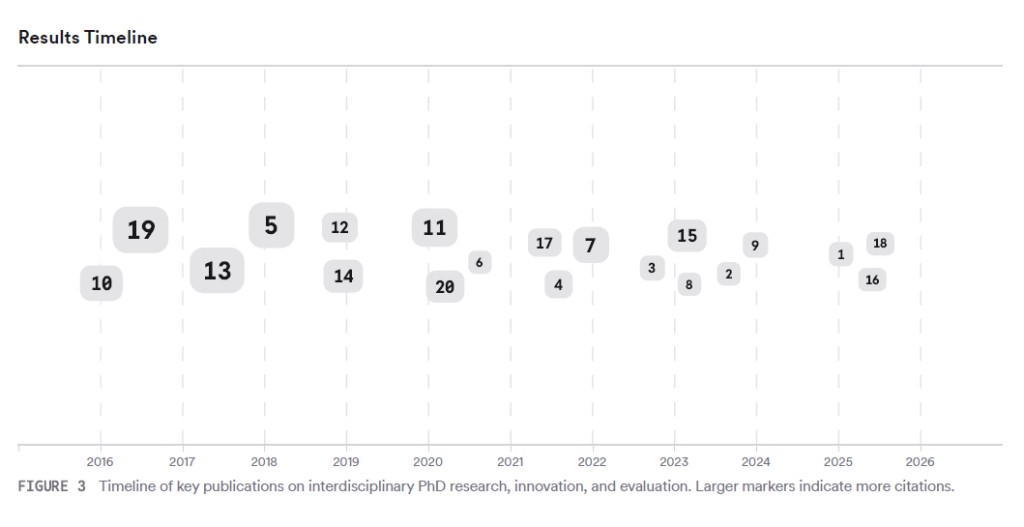
Figure 3: Timeline of key publications on interdisciplinary PhD research, innovation, and evaluation. Larger markers indicate more citations.
Top Contributors
| Type | Name | Papers |
|---|---|---|
| Author | N. Bosque-Pérez | (Bosque-Pérez et al., 2016) |
| Author | Ye Sun | (Sun et al., 2021) |
| Author | J. Newman | (Newman, 2023) |
| Journal | Research Policy | (Carr, Loucks and Blöschl, 2018; Leahey and Barringer, 2020; Biancani et al., 2018) |
| Journal | Sustainability | (Villeneuve et al., 2019; Christensen et al., 2021) |
| Journal | Humanities and Social Sciences Communications | (Liu et al., 2023; Rigolot, 2020) |
Figure 4: Authors & journals that appeared most frequently in the included papers.
4. Discussion
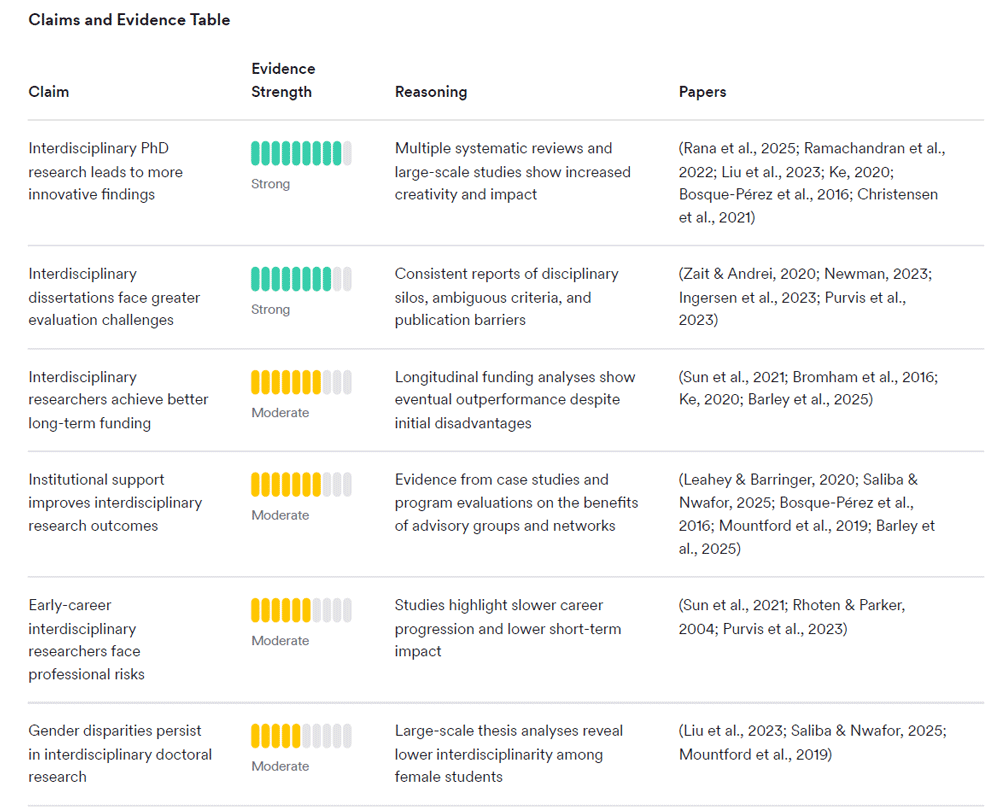
The literature demonstrates that interdisciplinary research during a PhD can drive innovation and equip graduates with versatile skills, but it also introduces significant challenges in dissertation evaluation and early career progression (Rana, Aitken and Chimoriya, 2025; Ramachandran et al., 2022; Sun et al., 2021; Liu et al., 2023; Ke, 2020; Bosque-Pérez et al., 2016; Christensen et al., 2021; Barley et al., 2025). The evidence supporting the innovative benefits of interdisciplinary research is strong, with multiple large-scale studies and systematic reviews confirming increased creativity, broader impact, and long-term funding advantages (Rana, Aitken and Chimoriya, 2025; Sun et al., 2021; Liu et al., 2023; Ke, 2020; Bosque-Pérez et al., 2016). However, the evaluation of interdisciplinary dissertations remains problematic due to entrenched disciplinary norms, ambiguous assessment criteria, and publication barriers (Zait and Andrei, 2020; Newman, 2023; Ingersen et al., 2023; Purvis et al., 2023). These challenges can deter early-career researchers from pursuing interdisciplinary paths, despite institutional efforts to incentivise such work (Rhoten and Parker, 2004; Newman, 2023; Purvis et al., 2023).
The quality of the research is generally high, with robust methodologies and large datasets supporting the main claims. However, some gaps remain, particularly in empirical studies on effective evaluation strategies and the long-term career outcomes of interdisciplinary PhD graduates (Newman, 2023; Purvis et al., 2023). The literature also highlights persistent gender disparities and the need for more inclusive support structures (Liu et al., 2023; Saliba and Nwafor, 2025; Mountford et al., 2019).
Claims and Evidence Table
| Claim | Evidence Strength | Reasoning | Papers |
|---|---|---|---|
| Interdisciplinary PhD research leads to more innovative findings | Evidence strength: Strong (9/10) | Multiple systematic reviews and large-scale studies show increased creativity and impact | (Rana, Aitken and Chimoriya, 2025; Ramachandran et al., 2022; Liu et al., 2023; Ke, 2020; Bosque-Pérez et al., 2016; Christensen et al., 2021) |
| Interdisciplinary dissertations face greater evaluation challenges | Evidence strength: Strong (8/10) | Consistent reports of disciplinary silos, ambiguous criteria, and publication barriers | (Zait and Andrei, 2020; Newman, 2023; Ingersen et al., 2023; Purvis et al., 2023) |
| Interdisciplinary researchers achieve better long-term funding | Evidence strength: Moderate (7/10) | Longitudinal funding analyses show eventual outperformance despite initial disadvantages | (Sun et al., 2021; Bromham, Dinnage and Hua, 2016; Ke, 2020; Barley et al., 2025) |
| Institutional support improves interdisciplinary research outcomes | Evidence strength: Moderate (7/10) | Evidence from case studies and program evaluations on the benefits of advisory groups and networks | (Leahey and Barringer, 2020; Saliba and Nwafor, 2025; Bosque-Pérez et al., 2016; Mountford et al., 2019; Barley et al., 2025) |
| Early-career interdisciplinary researchers face professional risks | Evidence strength: Moderate (6/10) | Studies highlight slower career progression and lower short-term impact | (Sun et al., 2021; Rhoten and Parker, 2004; Purvis et al., 2023) |
| Gender disparities persist in interdisciplinary doctoral research | Evidence strength: Moderate (5/10) | Large-scale thesis analyses reveal lower interdisciplinarity among female students | (Liu et al., 2023; Saliba and Nwafor, 2025; Mountford et al., 2019) |
Figure 5: Key claims and support evidence identified in these papers.
5. Conclusion
Interdisciplinary research during a PhD is a catalyst for innovation and skill development, but it also presents significant challenges in dissertation evaluation and early career advancement. Institutional support and evolving evaluation criteria are essential to fully realise the benefits of interdisciplinary doctoral research.
5.1. Research Gaps
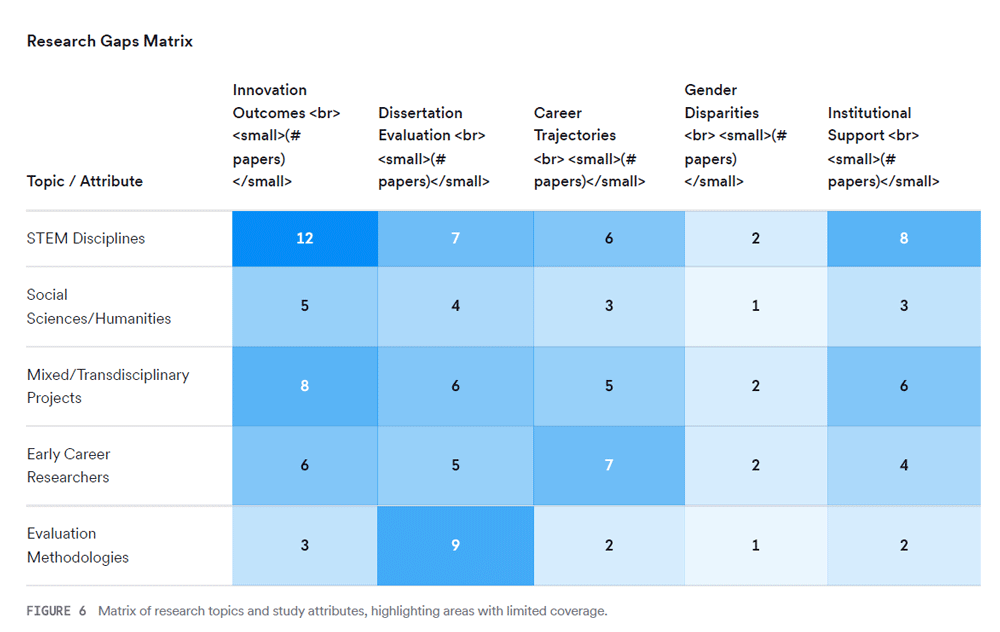
Despite substantial progress, gaps remain in empirical research on effective dissertation evaluation strategies, long-term career outcomes, and the impact of institutional interventions. Gender disparities and the integration of social sciences and humanities in interdisciplinary projects also warrant further investigation.
Research Gaps Matrix
| Topic / Attribute | Innovation Outcomes (# papers) | Dissertation Evaluation (# papers) | Career Trajectories (# papers) | Gender Disparities (# papers) | Institutional Support (# papers) |
|---|---|---|---|---|---|
| STEM Disciplines | 12 | 7 | 6 | 2 | 8 |
| Social Sciences/Humanities | 5 | 4 | 3 | 1 | 3 |
| Mixed/Transdisciplinary Projects | 8 | 6 | 5 | 2 | 6 |
| Early Career Researchers | 6 | 5 | 7 | 2 | 4 |
| Evaluation Methodologies | 3 | 9 | 2 | 1 | 2 |
Figure 6: Matrix of research topics and study attributes, highlighting areas with limited coverage.
5.2. Open Research Questions
Future research should focus on developing robust evaluation frameworks for interdisciplinary dissertations, understanding long-term career impacts, and addressing gender disparities in interdisciplinary doctoral research.
| Question | Why |
|---|---|
| How can dissertation evaluation criteria be adapted for interdisciplinary PhD research? | To ensure fair and effective assessment of innovative, cross-disciplinary work and support academic advancement. |
| What are the long-term career outcomes for interdisciplinary PhD graduates? | Understanding these outcomes can inform training, support, and policy for doctoral education. |
| How can gender disparities in interdisciplinary doctoral research be reduced? | Addressing this gap is crucial for equity and maximising the innovative potential of diverse researchers. |
Figure 7: Key open research questions for future investigation.
In summary, while interdisciplinary PhD research drives innovation and broadens career prospects, overcoming evaluation and structural barriers is essential to fully harness its potential.
References
- Rana, K., Aitken, S., & Chimoriya, R., 2025. Interdisciplinary Approaches in Doctoral and Higher Research Education: An Integrative Scoping Review. Education Sciences. https://doi.org/10.3390/educsci15010072
- Murray, R., Marbach‐Ad, G., McKee, K., Lansing, S., Winner, M., & Sapkota, A., 2023. A curricular model to train doctoral students in interdisciplinary research at the food-energy-water nexus. Frontiers in Education. https://doi.org/10.3389/feduc.2023.1114529
- Ramachandran, A., Abdi, K., Giang, A., Gladwin, D., & Ellis, N., 2022. Transdisciplinary and interdisciplinary programmes for collaborative graduate research training. Educational Review, 76, pp. 996 – 1013. https://doi.org/10.1080/00131911.2022.2134312
- Belcher, B., Claus, R., Davel, R., & Jones, S., 2021. Evaluating and improving the contributions of university research to social innovation. Social Enterprise Journal. https://doi.org/10.1108/sej-10-2020-0099
- Carr, G., Loucks, D., & Blöschl, G., 2018. Gaining insight into interdisciplinary research and education programmes: A framework for evaluation. Research Policy, 47, pp. 35-48. https://doi.org/10.1016/j.respol.2017.09.010
- Zait, A., & Andrei, A., 2020. Innovating a City Through Citizen Participation: Could Interdisciplinary Orientation Play a Role?. EduRN: Other Social Sciences Education (Topic). https://doi.org/10.24989/ocg.338.25
- Sun, Y., Livan, G., , A., & Latora, V., 2021. Interdisciplinary researchers attain better long-term funding performance. Communications Physics, 4. https://doi.org/10.1038/s42005-021-00769-z
- Carneiro, M., & Santos, R., 2023. FROM A CONCEPTUAL KNOWLEDGE FRAMEWORK TO A DECISION SUPPORTING SYSTEM: ALIGNING SCIENTIFIC AND STARTUP DEVELOPMENT. Anais do XII Congresso Internacional de Conhecimento e Inovação (ciKi). https://doi.org/10.48090/ciki.v1i1.1359
- Liu, M., Yang, S., Bu, Y., & Zhang, N., 2023. Female early-career scientists have conducted less interdisciplinary research in the past six decades: evidence from doctoral theses. Humanities and Social Sciences Communications, 10, pp. 1-16. https://doi.org/10.1057/s41599-023-02392-5
- Menken, S., & Keestra, M., 2016. An Introduction to Interdisciplinary Research. **. https://doi.org/10.5117/9789462981843
- Leahey, E., & Barringer, S., 2020. Universities’ commitment to interdisciplinary research: To what end?. Research Policy, 49, pp. 103910. https://doi.org/10.1016/j.respol.2019.103910
- Gibson, C., Stutchbury, T., Ikutegbe, V., & Michielin, N., 2018. Challenge-led interdisciplinary research in practice: Program design, early career research, and a dialogic approach to building unlikely collaborations. Research Evaluation. https://doi.org/10.1093/reseval/rvy039
- Kaplan, S., Milde, J., & Cowan, R., 2017. Symbiont Practices in Boundary Spanning: Bridging the Cognitive and Political Divides in Interdisciplinary Research. Academy of Management Journal, 60, pp. 1387-1414. https://doi.org/10.5465/amj.2015.0809
- Morss, R., Lazrus, H., & Demuth, J., 2018. The “Inter” Within Interdisciplinary Research: Strategies for Building Integration Across Fields. Risk Analysis, 41. https://doi.org/10.1111/risa.13246
- Newman, J., 2023. Promoting Interdisciplinary Research Collaboration: A Systematic Review, a Critical Literature Review, and a Pathway Forward. Social Epistemology, 38, pp. 135 – 151. https://doi.org/10.1080/02691728.2023.2172694
- Saliba, S., & Nwafor, C., 2025. The Inclusion of an Interdisciplinary Expert Advisory Group in Doctoral Research on Chaplaincy: Insights from Two Doctoral Researchers.. The journal of pastoral care & counseling : JPCC, pp. 15423050251340984. https://doi.org/10.1177/15423050251340984
- Trinh, M., Kirsch, R., Castillo, E., & Bates, D., 2021. Forging paths to interdisciplinary research for early career academics. Academy of Management Learning & Education. https://doi.org/10.5465/amle.2019.0386
- Tomescu-Stachie, S., 2025. Innovate to elevate: How creative research methods and interdisciplinary collaboration can address health inequalities. Health Psychology Update. https://doi.org/10.53841/bpshpu.2025.34.1.48
- Pedersen, D., 2016. Integrating social sciences and humanities in interdisciplinary research. Palgrave Communications, 2. https://doi.org/10.1057/palcomms.2016.36
- Lindgreen, A., Di Benedetto, C., Brodie, R., & Van Der Borgh, M., 2020. How to undertake great cross-disciplinary research. Industrial Marketing Management, 90. https://doi.org/10.1016/j.indmarman.2020.03.025
- Bromham, L., Dinnage, R., & Hua, X., 2016. Interdisciplinary research has consistently lower funding success. Nature, 534, pp. 684-687. https://doi.org/10.1038/nature18315
- Ingersen, A., Soendenbroe, C., Ahmed, H., Borch, J., Moseholm, K., Dal, M., Kusta, O., Bergien, S., & Gillberg, L., 2023. Should young researchers engage with interdisciplinary research?. Acta Physiologica, 239. https://doi.org/10.1111/apha.14053
- Villeneuve, D., Durán-Rodas, D., Ferri, A., Kuttler, T., Magelund, J., Mögele, M., Nitschke, L., Servou, E., & Silva, C., 2019. What is Interdisciplinarity in Practice? Critical Reflections on Doing Mobility Research in an Intended Interdisciplinary Doctoral Research Group. Sustainability. https://doi.org/10.3390/su12010197
- Ke, Q., 2020. Interdisciplinary research and technological impact: evidence from biomedicine. Scientometrics, 128, pp. 2035 – 2077. https://doi.org/10.1007/s11192-023-04662-0
- Rhoten, D., & Parker, A., 2004. Risks and Rewards of an Interdisciplinary Research Path. Science, 306, pp. 2046 – 2046. https://doi.org/10.1126/science.1103628
- Newman, J., 2023. Incentivising interdisciplinary research collaboration: evidence from Australia. Journal of Higher Education Policy and Management, 46, pp. 146 – 165. https://doi.org/10.1080/1360080x.2023.2267719
- Purvis, B., Keding, H., Lewis, A., & Northall, P., 2023. Critical reflections of postgraduate researchers on a collaborative interdisciplinary research project. Humanities & Social Sciences Communications, 10. https://doi.org/10.1057/s41599-022-01494-w
- Bosque-Pérez, N., Klos, P., Force, J., Waits, L., Cleary, K., Rhoades, P., Galbraith, S., Brymer, A., O’Rourke, M., Eigenbrode, S., Finegan, B., Wulfhorst, J., Sibelet, N., & Holbrook, J., 2016. A Pedagogical Model for Team-Based, Problem-Focused Interdisciplinary Doctoral Education. BioScience, 66, pp. 477-488. https://doi.org/10.1093/biosci/biw042
- Biancani, S., Dahlander, L., McFarland, D., & Smith, S., 2018. Superstars in the making? The broad effects of interdisciplinary centers. Research Policy, 47, pp. 543-557. https://doi.org/10.1016/j.respol.2018.01.014
- Christensen, J., Ekelund, N., Melin, M., & Widén, P., 2021. The Beautiful Risk of Collaborative and Interdisciplinary Research. A Challenging Collaborative and Critical Approach toward Sustainable Learning Processes in Academic Profession. Sustainability, 13, pp. 4723. https://doi.org/10.3390/su13094723
- Mountford, N., Coleman, M., Kessie, T., & Cusack, T., 2019. Interdisciplinary doctoral research networks: enhancers and inhibitors of social capital development. Studies in Higher Education, 45, pp. 2558 – 2573. https://doi.org/10.1080/03075079.2019.1623768
- Rigolot, C., 2020. Transdisciplinarity as a discipline and a way of being: complementarities and creative tensions. Humanities and Social Sciences Communications, 7. https://doi.org/10.1057/s41599-020-00598-5
- Barley, W., Dinh, L., Johnson, L., & Allan, B., 2025. Membership in team science institute enhances diversity of researchers’ collaboration networks. PLOS One, 20. https://doi.org/10.1371/journal.pone.0322943